
Do you and/or your doctor believe hormone replacement therapy is dangerous? Consequently, are you suffering from menopause that has no end in sight?
Perimenopause and menopause can have brutal and debilitating symptoms that don’t necessarily disappear come postmenopause. Many women are needlessly suffering. Often these symptoms are so severe they affect a woman’s:
- Personal and professional relationships,
- physical and mental health, and
- therefore, quality of life.
Hormone Replacement Therapy (HRT): replaces the estrogen, progesterone and the little bit of testosterone a woman’s body is no longer producing. The correct dosage of HRT alleviates the symptoms of perimenopause, menopause, and postmenopause. (Sometimes called Menopausal Hormone Therapy – MHT)
There’s such an irony to the saga of hormone replacement therapy. The pendulum has swung so widely, from “hormone therapy is good for all women” to “it’s bad for all women” to now somewhere in between.
— Dr. JoAnn Manson – Lead investigator of the Women’s Health Initiative
Women’s Health Initiative Study
This massive fifteen-year study included more than 160,000 post menopausal women from fifty to seventy-nine years old.
The study’s first findings, published in 2002, said hormone replacement therapy increased the risk of both breast cancer and heart disease. Doctors started pulling their patients off HRT. Almost 50%!
But the information has changed.
The final comprehensive report, published in 2013, maintained that age needed to be taken more into consideration. Meaning that for younger healthy women, hormone replacement therapy may not be such an ominous prescription.
Unfortunately, many doctors and pharmacists are still recommending the results of earlier flawed studies rather than keeping themselves up to date.
“We have had time and resources to carefully tease out the data and perhaps collect a little bit more information, and what we have found at least reassures us that for some women who have menopausal symptoms, HRT is not the ominous prescription we thought when the data first came out.”
– Cynthia Stuenkel, MD, Professor of Medicine at the University of California at San Diego
The Flaws in The Studies
- Women’s Health Initiative Study (WHI) from 1993 – 2002 studied the effects of HRT on over 16,600 U.S. women.
- The Million Women Study (TMW) from 1996 – 2001 studied the effects of HRT on one million U.K. women.
* Note: All studies are flawed in one way or another mostly because “total control” is impossible. Nevertheless, studies are important as they provide a baseline.
The WHI and TMW Studies included the following shortcomings:
- WHI studied only one dose and type of combined HRT: conjugated equine estrogens (Premarin) and medroxyprogesterone (Provera) or estrogen-only HRT.
- Both studies included mostly women who were older than sixty and already ten years postmenopausal.
- At this age they were already at an increased risk for stroke, heart disease, and breast cancer.
- The majority of women were already overweight.
- Allowances weren’t made for diet, exercise, alcohol consumption, or smoking.
- The TMW study wasn’t a randomized controlled trial, where two groups of women are recruited, half given HRT, and half a placebo.
“So,” I said to the pharmacist. “In your professional opinion, will these little pills kill me? You know, heart attack, stroke, cancer, and so forth.”
“No,” he said, smiling.
“Well, plenty of people are freaking out when I tell them that I’m taking this. Is your answer based on the Women’s Health Initiative Study?”
“Yes,” he said. “There were women who fell to diseases, but they already had issues in these same areas, so it doesn’t prove anything. Besides, your estrogen dose is low and you’re taking the progesterone to counter any effects. What’s more, women have been on birth control pills for years without detriment.”
I smiled because that’s exactly what I thought and handed him my credit card.
– Samantha’s story (52 years old)
Bio-identical Hormone Replacement Therapy

Many women are erroneously led to believe that bio-identical:
- Means compounded hormones bought from compounding pharmacies.
- Is more “natural” being derived from plants and customized to the patient.
- Is safer than the FDA approved estrogen and progesterone produced/distributed by pharmaceutical companies.
False. All HRT prescriptions are bioidentical.
First Fact: Any hormone — whether from a compounding pharmacy or a pharmaceutical company — requires chemical processing to synthesize it into a usable product: cream, spray, patch, or pill.
Second Fact: “Bio-identical” and “natural” are unregulated terms, open to interpretation, and used to manipulate the most purchases.
Third Fact: Manufacturers extract estrogen from plants and synthesize it in to estradiol molecules. Compounding pharmacies and pharmaceutical companies buy identical estradiol molecules.
Fourth Fact: Compounding pharmacies are not fully regulated by the FDA.
Fifth Fact: Pharmaceutical companies must legally back up their claims, perform drug approval testing, and quality assurance. They’re also required to report all findings — negative and positive — and list all possible side effects and safety risks.
– The above facts are summarized from the article, Buyer Beware: “Bioidentical” Hormone Myths, by Doctor Lauren Streicher, Gynecologic Specialist, Assistant Clinical Professor of Obstetrics and Gynecology at Northwestern University’s Feinberg School of Medicine
When I was first prescribed hormone replacement therapy, I took the recommended dose every day:
- Estrace / Estradiol 1.0 MG
- Promentrium / Progesterone 100MG
I swear I reversed aged about seven years. I felt fantastic. But after a while, I began to experience extreme breast tenderness, indicating excess of estrogen or lowered progesterone.
Makes sense. My hormones fluctuate on a day-to-day basis
I cut the Estradiol 1.0 MG pill in half and started taking 0.5MG on a daily basis. For a while, this worked well.
But every now and again on this lower dose, the symptoms came back (hot flashes or itchiness). So I cut the 0.5MG pill in half again and when these symptoms come on, I take an extra 0.25MG just for one day. This also works well.
Estrogen and Progesterone operate on a negative feedback loop, meaning one keeps the other in check. So another way to manage fluctuating symptoms is to take Estradiol 0.5MG daily and miss the Progesterone 100MG twice per week.
Because I’m in touch with my body, monitoring my symptoms and adjusting my dosage works well for me.
– Jessica’s Story (59 years old)
Hormone Testing
There’s been much hoopla about salivary hormone testing being more accurate than the traditional doctor-prescribed blood test. The purpose: enabling a compounding pharmacist to customize the hormone level to the individual.
False.
Women’s hormones fluctuate daily. Accurately testing levels of estrogen and progesterone today will do nothing to help the patient tomorrow.
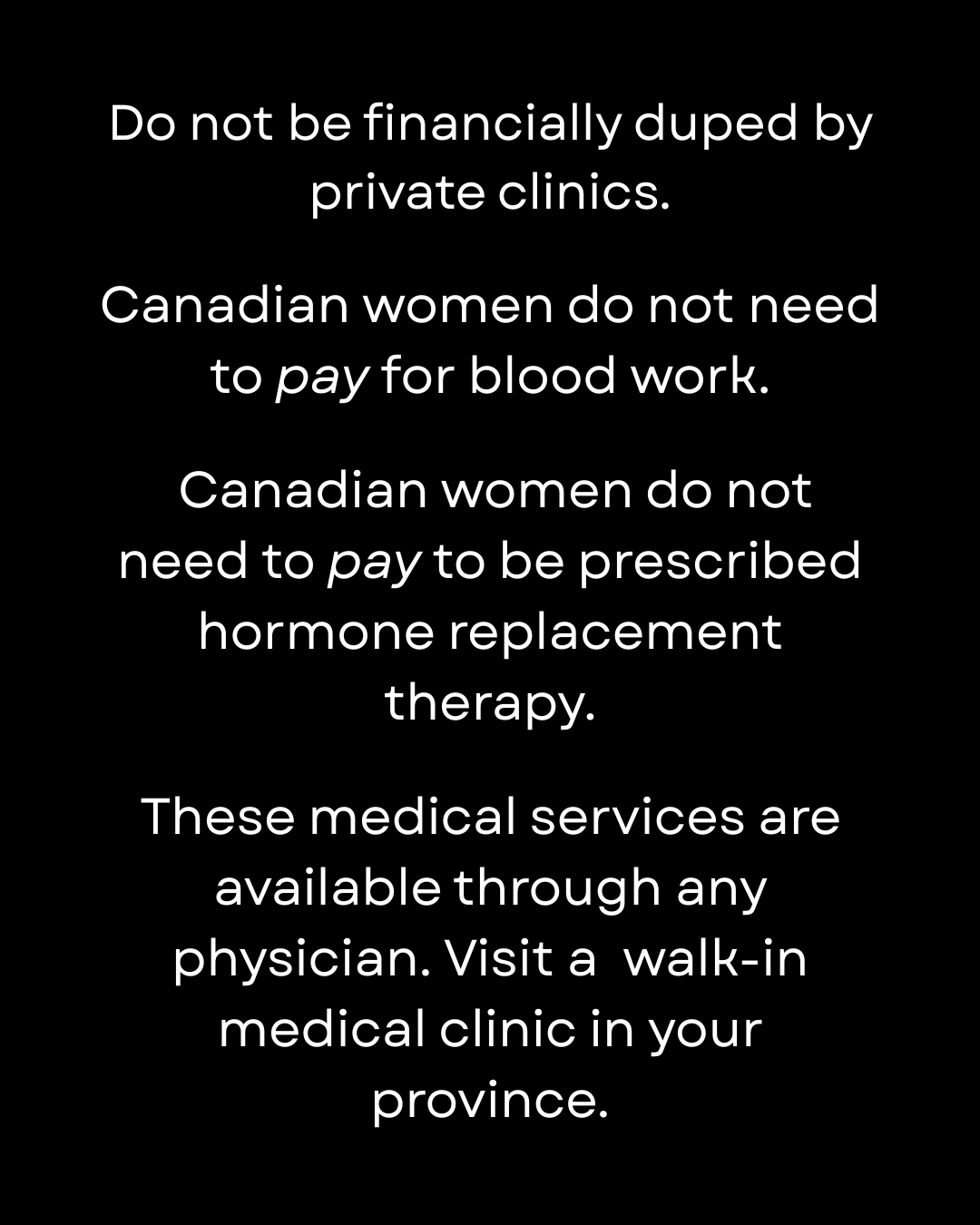
The initial blood test your doctor requisitions ensures your symptoms stem from decreased hormone levels and not from diseases.
- Post-menopausal Estrogen levels: < 120 pmol/L
- Post-menopausal Progesterone levels: < 2 nmol/L
Therapies Must Consider the Risk/Benefit Ratio
Regulated healthcare professionals must ensure the benefit of a therapy is higher than the risk.
Thus, women experiencing quality of life deterioration due estrogen/progesterone decline can confidently ease their suffering through hormone replacement therapy as prescribed by their physician and as distributed by a pharmaceutical company. As long as:
- It alleviates the symptoms of menopause (osteoporosis prevention requires long-term use).
- It’s at the lowest effective dose and only for as long as necessary.
- It’s under the yearly assessment of a physician.
Two hundred years ago, women in their forties and fifties were considered elderly and already nearing the end of their lives.
Today, readily available nutrition and medical science keeps us healthy and younger much longer.
My opinion: evolution of the human body has not kept up with our rapid advance in longevity. Hence the need to maintain estrogen and progesterone levels needed to keep our physical and mental selves strong and healthy.
Hormone replacement therapy isn’t really a drug. It’s more as though I’m replacing something (hormones) that are supposed to be in my body anyway. Like vitamins.
That’s my opinion and I’m sticking to it!
– Olivia’s Story (51 years old)
A Healthy Lifestyle Helps Tremendously

Regardless of whether or not you choose to take HRT, paramount is the decision to choose a healthy lifestyle:
- Eat real food — starting with breakfast each morning.
- Drink lots of water.
- No smoking and consume alcoholic beverages in moderation.
- Participate in cardiovascular exercise, weight-training, and stretching.
- Sleep seven to nine hours a night.
- Re-organize life and relationships to reduce stress and increase happiness.
This Information Doesn’t Replace a Doctor’s Advice
HRT must be evaluated by each woman individually accompanied by her physician. Lifestyle, medical history, and family medical history must be considered.
Citations
- Avrum Z. Bluming, MD, & Carol Tavris, PhD. (2009) Hormone Replacement Therapy: Real Concerns and False Alarms. http://www.breastcancerchoices.org/
- Nancy Shute (interviewing Dr. JoAnn Manson). (2013) The Last Word On Hormone Therapy From the Women’s Health Initiative. http://www.npr.org/
- Lauren Streicher, MD. (2011) Buyer Beware: “Bioidentical” Hormone Myths. http://www.doctoroz.com/
- Harvard Women’s Health Watch. (2006) What Are Bio-identical Hormones? Published by Harvard Medical School.
Medical Websites Used For Research
- mayoclinic.org
- webmd.com
- nia.nih.gov (National Institute on Aging)
- nhlbi.nih.gov (National Heart, Lung and Blood Institute)
- health24.com
- medscape.com
- Also the textbook, Principles of Anatomy and Physiology, by Tortora & Grabowski
Are you ready to weight train once a week? Contact us today:
Personal training is by appointment only.
Please email: LeongOrthopaedicHealth@gmail.com
Share this with someone you care about!
All rights reserved; no part of this publication may be reproduced or transmitted by any means, electronic, mechanical, photocopying or otherwise, without prior permission. Copyright 2021.